Thursday, June 30, 2011

Inspirations for Coursework Final

1: Chinese Scroll Paintings


Inspired by Chinese scroll, i was fascinated by the idea of the Chinese scroll painting opening up before the viewer, allowing the viewers' eyes to travel through the landscape to pick up the unexpected and surrealistic details. 
 
I will probably combine my five painting linked into one, with there being some sort of connection between landscapes. The size of the paintings will be small so that the viewers can view the landscape at eye level and is able to take in the painting fully, as a whole.

There will be Inclusion of a character engaged in different activities throughout the landscapes. This adds interest to this painting, almost like a story-book. And it also brings across the idea of these landscapes being perceived through my character’s eyes.

Originally, i wanted to do the final as oil on canvas, yet now i have decided to keep the pen works and opt for watercolour and pen as a medium instead as this is more practical for the small scale which i am going for. Also, i feel that the pens works and slightly stylized forms helps to add sparks to the landscapes.  

 2: 


Inspiration: London and Paris trip

The AEP London and Paris was a great source of inspiration for the subject matter of my coursework.

The travel really opened up my eyes to the wonders of the world. More significantly, beyond the land marks and magical, charismatic scenes that were attractive and endearing, it opened my eye to the possibilities of art in our everyday surroundings.

The architecture, the greenery, the people, the food. Everything had potential, and possibilities.

The peoples' great appreciation of art, acceptance towards various forms of art and astonishing enthusiasm towards art motivated me. 

In my opinion, London and Paris were cities that spoke art to me, it embodies art.

After the trip, returning to Singapore, i pondered on the prevalence of art in our country.  In the hustle and bustle of London and Paris, people seem to be appreciative of art. However, within Singapore, there seems to be no signs of such. I think it is important, no matter what sort of life we lead, busy or quiet, we need to enjoy art and feel art in our surroundings. Therefore, an idea came across me to do something related to appreciating art in our everyday lives by learning to see the possibilities to create art in our surroundings. Art is highly prevalent in some societies, less so in some.

TK Sabapathy Talk

Main themes and Topics / Some opinions brought up:

Artist

Little is known about the Artist : 

Indeed, we lack knowledge of the artist many a times and what we know of the artist is just insufficient for deeper interpretation of the work to make connections between Art and Artist.


Is it important to understand the Intention of the Artist?: 

There is always a dilemma whether we should "get inside" the Artist or the Art work first.

Does the best quality opinion comes from the Artist?:

I think that this is not absolute. It is possible to argue against the artist after learning about the Artist’s intent with your own substantiated opinion.
Is the intention of the Artist acting as a restriction/constrain for the individual?:

Through the history of Art, the ambition to make sense does not stop.

Is the intention of the person looking at it equally important?:

There is certain school of thought that discards the Artist entirely in the interpretation of the meaning of the work. The focus is “Me and the work, the work and me” Is this where it all begins and ends?:

Choices an artist makes in making the piece of work may not be just to satisfy immediate need?
Choices here means the choices of resources, determined by predecessors.
Choices made also falls into the domain of intention

When asked what are the joys he experiences as an art historian, he said that his joy is in the act of writing due to his deep fascination with language. To him, language reveals, conceals, operates, impedes, facilitates, postpone things, just like an agency that keeps you in a writing room.


Audience

The artist is primarily the first audience of the work, though we seldom realize that. For example, when Picasso pins up his work and view it from afar, he is presuming the role of an audience.

It is not easy for viewers to be able to discover, come by the physiological disposition, inner emotion. Therefore, how do we relate to the work?:

Is the work the direct cause of what has been disclosed to us? In other words is the saying “The work is the Artist, the Artist is the work” true?:

Why are we as audience so obsessed with meaning?:

When there is a contradiction between the artist’s interpretation and yours, will the artist’s interpretation can change the work for you?:

When somebody interpret an artwork, the person has already internalized her views beforehand based on prior learning and experiences.

Art is firstly about making the visual connection.

Context

Dates are not just numbers on the calendar, they radiate all kinds of other creations.

Nanyang Style
Dates: visit to Bali (1952) Exhibition (1953)
What prompted the visit? What was it from the visit that inspired artists to later create the nanyang style?

How to stitch all these together to make a interesting composition?
A context do not preexist, it is constructive and it brings together data to form a sensible report/account to your own interest/writing.

Interpretation of Art 

one interpretation is the beginning of another

Is there such a thing as over-interpretation? Is there a limit to which you can push things? Interpret too much, too little?:

Does the significance of a work is through the act of interpretation, where to work takes on a public profile, presence, prominence? In other words, until a piece of work is talked about in the public arena, its significance is not yet set?:
 

 Language for interpretation
Can language capture what the Artist is thinking?:

How did the interpretations come about?:

I think some interpretation is begins as thoughts, something internal, but this later takes the form of conversation and writings.

If one is free to interpret, why would one’s own opinion be of interest to someone else? Or rather, how could that be made of interest to someone else?:

When it is fresh, taken from a new perspective that opens the viewer’s eyes

Art made Commercialized, can Art remain purely art? 

For Art, we need to understand that there are many powerful forces at work. Art could be used for propaganda, or produced for propaganda, which is what happens many a times in history.

Censorship Controversies

When subject matter cross certain kinds of boundaries/convention, should it be censored?:

Who decides what to censor?
 
Entry of political regime into art

Is SAM doing well as a guardian? Has it lost its way in what it set out to do?:

This is perhaps due to the lack of art education; this will help to provide directors, curators, writers, publicist, and makers of promotional videos.Art education is Singapore does not allow mid-way house, as is considered unproductive for many.Lack of training for curators as civil service does not recognize Museum workers as professionals.

Does Branding, Marketing and Commercialization brings the collapse of ethics and morality in the world? This depends on how morality is directed into the creative world?:


Globalization

Cultures around the world may have different cultures and rules.
We need to recognize that all artists like human beings are social beings. As social beings, we are aware of the social environment we live in and produce what we produce.

Artists should live out to the maximum of responsibility to self and to the social media. The assertion of individuality cannot be completely suppress by responsibility and it responsibility may not be obligation that suppress individuality.

Ethics and Art
 
Is the immorality in Art? Can it be conceptualized?:

However, we need to bear in mind that aesthetic and commercial are always connected.

However, I would choose to believe that no artist starts with the aim of being irresponsible as artists would then self destruct.
Responsibility present in Norms, Conventions (Outward Bounce Markers)

Closer to body, greater sense of awareness of what is going on.

Further prompting Questions:

Do we expect too much out of art?
Have we considered what do pictures want?
Do works of Art has an innate life beyond what we interpret them as?

Thursday, May 19, 2011

Lucia Hartini Assignment


1a) Describe the use of space, colour and brushwork.

This painting depicts an authoritative, challenging, strong, daring and powerful character of Srikandi, a daring female knight character of the Javanese shadow theatre. The figure clenches her fists with muscled hands, her head up with wide-open staring eyes, constituting a strong challenging gesture against the spying eyes before her.

 In terms of the use of space, almost three quarter of the space is dominated by the woman figure right at the front of the painting. There is also a rather distinct diagonal line from the centre of the left vertical axis to the top right hand corner that separates the sky, clouds and sun from the concrete brick maze-like walls in the right. Right behind the figure is a zig-zag maze like brick-wall that continues all the way to the back of the painting, until it is cut off at the end of the canvas.

As for the use of colour, it can be observed that the colours used are rather intense and rich, adding a surrealistic feel to the painting. The female figure’s velvety dress is a dark rich blue, whereas her skin tone is one of olive-brown with some highlights of white and yellow to define her feature under the light. Also, the fact that the female hair is black indicates that she is most probably an Asian. Furthermore the brick walls that appear to be cracking is an intense crimson red of different shades in different areas: red where shadows are reflected are tinged with some black while red where light is shone upon is lighter and brighter, with a tinge of yellow. In the background, the white fluffy clouds lie above and within dark blue skies, while the sun is white tinged with some blue in certain area and the clouds at a higher altitude appears in orange, yellow and white. As for the sight reflected from the figure eyes, the sky and clouds is similar to the background in shades of blue, white and orange while the numerous eyes has black pupils and orange-yellow eyelids. In this work, complementary colours are used (Indigo and Orange) (Red and Blue). When the colours clash and make each other look brighter and cause discomfort when placed together, creating tension in the painting.

Regarding the brushworks used in this painting, brushworks are almost invisible and paint is probably applied to the canvas in extremely fine lines. Lucia Hartini's works have been marked by her ability to transform terror into marvels of yearning or awesome visions, epitomized by a spiraling vortex and meticulously painted waves or skies built up with layers of small and carefully modulated brush strokes.


1b)

This work has many influences behind it.

Firstly, the artwork is influenced by the artist own experience of gender discrimination in the social conditions in Indonesia, where she lives in, where the traditional cultural expectations is that women should obediently and patiently placed themselves as  victims of sexism, and act as an obedient subject to male admonition. Therefore, being a Indonesian female living in such a society, she is a victim of sexism as well. Besides, she is also a victim of domestic violence. Therefore, as time passes, her fears from the suffering she endured her paintings reveal a self that gradually emerged from invisibility into visibility, from fear into grieving and then into determination and confidence, from powerlessness to a recognition of her own fighting powers. Through this art piece, she then explored her empowered moments. Therefore, with her new beliefs that women should represent themselves as autonomous subjects having potential which is different but no less capable than man in this shared world or in simple terms, gender equality, she wishes to express her thoughts as well as advocate as a modern Indonesian/global woman fighting for her right to define her own place in the world through this painting that depicts the confidence and great capabilities within a female figure that dominates the centre of the painting.

Secondly, the choice of the female subject in the painting to be Srikandi as a depiction of a confident woman like the artist herself could be due to the artist’s cultural background. Being a Indonesian, the artist has have known of Srikandi, is a favourite character from the Hindu epic, the Mahabharata, well known throughout Indonesia and taken a liking for this authoritative, challenging, strong and powerful daring female knight and is highly inspired to be like her thus depicting herself as Srikandi. The story behind the character is that Srikandi was determined to become the wife of the Pandwa prince, Arjuna, despite the fact that she was already married to Dewi Sumbadra. Srikandi vowed to stand by Arjuna in battle, impressing him with her loyalty and courage. This she did in the Bratayuda War, slaying his enemies; later she was murdered by poison. Therefore, Srikandi is the archetypical “Warrior Woman” of South-East Asian legend. In this case Lucia painted herself as Srikandi showing how stridently she repels the critical and doubting eyes of society which had formerly rendered many of its women prisoners of tradition.

Thirdly, it can be observed that this work is influenced by the Surrealism movement of the western art world and resembles the style of surrealism artist Salvador Dali.
Surrealism is an art movement concerned with the projection of the subconscious mind and dreams and the subjects matter is often related to dreams and fantasy. Similarly, this painting’s subject matter belongs to the world of fantasy as the female subject having such as vision of the sky and eyes is abnormal. More specifically, this artwork would belong to Super Surrealism , which as a kind of surrealism was based on the irrational combination of unrelated objects and contrasting forms derived from the depths of imagination or the dream world. It was a fusing of the dream world with reality to bewilder the viewer. This is greatly reflected in the work from the great contrast of the soft drapery around the figure and the rough, textured cracking walls as well as the contrast of the fragility and feminity easily associated with a female figure with the strong and firm stance she bears. Despite the figure being realistic, it is mixed up with unreality when the figure possesses an x-ray vision that views the skies and numerous eyes. Furthermore, like in super surrealism, the forms in this painting were treated with realistic, highly academic accuracy using traditional painting techniques, with the figure looking really realistic perfected in almost invisible brushstrokes. Her painstaking attention to the details of painting further suggests an almost obsessive preoccupation with personal reality, at the same time articulating spiritual forces that place her in direct contact with the surrealistic world. Lastly, similar to paintings by Salvador Dali, this work is one depicting a rather hallucinatory and mysterious scene where the numerous eyes seem to be spying and gazing in a haunting way and the background of the clouds and skies being so intensified in colour that it adds a touch of unreality and mysteriousness.  Therefore, with her fusing of past and present, conscious and unconscious in a single blinding moment of clarity, her work seem to be driven by the new spiritual dynamic that has taken her out of the corners of anxiety and depression, which is most probably highly influenced by Surrealism.


Friday, May 13, 2011

Coursework - Composition 3 (Europe (Nature))


 This is a surrealistic composition of different elements in nature. I was intrigued by the underwater life thus i tried to combine it with the land and houses. Also, i added in certain surrealistic elements that i have been working on for a while. I would say i am not too please with the watercolour results for i used normal printing paper instead or watercolour paper and the paint just could not be blended properly when i used this type of paper.


                         Zooming into the surrealistic details


A mermaid on land 

The horse and the child. 

1) Feathers of swan turning into waves . 2) Birds vs. boat.  3)Night vs. Day.

  
Girl feeding mermaid with water. I thought this was a interesting yet hilarious idea since mermaids live in a environment filled with water yet the water is too salty to be suitable for drinking.

Thursday, May 5, 2011

A valid interpretation of an artwork is dependent on an understanding of the artist’s intent and the context in which it was created?

Take a position for or against the given topic and support your stand with valid arguments and examples of artist/artworks


 I disagree that a valid interpretation of an artwork is dependent on an understanding of the artist's intent and the context within which it is created. Art, unlike many other academic subjects such as math and science, has no boundaries and no definite answer to it. Similarly, a boundary within which an interpretation of an artwork is considered valid should not be established, or rather it is non-existent.


Firstly, I do acknowledge that Artists definitely does have intent when creating a work, and there is a context within which she created it, upon which the artist would base her interpretation. It would be fair to say that this interpretation is the original intention, but it may not be the only interpretation that is valid.


In my opinion, so long as the viewer is able to substantiate her own interpretation of the artwork with reasons on her own, her interpretation is valid. Despite so, some viewers are not able to point out the reasons behind their interpretation, as their interpretation is solely based on initial reactions and instinctive feelings towards that work. In such cases, although others may not understand her interpretation, it does not deem this interpretation invalid, but rather, it can be considered personal one that only applies to her.


Art is something personal, and it can serve very different purposes for people with different values, aesthetic needs and people living in different context (environment and  time period). When a piece of art is put before the public, it would naturally be interpreted in various ways, and these interpretations may not be based on the artist’s intent and context which viewers initially know not of. Though their interpretation may not be in line with that of the artist, it is not invalid or unacceptable. We should understand that art is flexible and can be perceived from various perspectives, and all these perspectives can be valid.


Taking Jackson Pollock's "Number 1 (Lavender Mist)" for example. To the artist, the painting is created to capture the artist's pure virtuosity of paint handling and to allow to viewer to trace the rhythmic movements in the long arcs, staccato dribbles, or coagulated pools of color that accrue into a rich, shimmering interlace. With this intent, the artist original interpretation of this work would be that this is a total symphonic composition and this speaks of the struggle against alienation, fragmentation and disintegration that displays order out of chaos. However, when this piece of work is placed before the public that may be oblivious to the artist's intent, it is open to various interpretations. Unaware of Pollock's drip technique (action painting), people may interpret this painting as a suggestion of astronomical photographs of nebulae and galaxies. To others, the close up details of this painting may resemble microscopic photos of molecular structures. On one hand one could interpret it is an nuclear explosion (signified by the "explosion" of paint), on the other hand, some may say it is a painting that serves to brings peace to the mind with the soft hues of white, grey and light-lavender that brings a soft tonal effect. As seen, interpretations can be extremely diverse and independent of an understanding the artist’s intent and the context within which it was created. Yet, they are perfectly acceptable, reasonable and valid.

  
In conclusion, Art is about an individual making her own connections with the art. It need not be based on the original ideals of the Artist. As long as the individual feels the unique connection with a piece of art, and wants to interpret it her own way, I would say that she is free to do so and her interpretation should not be judged.


Friday, April 22, 2011

Working on Elements


Making Elements surreal. Will probably integrate some of these elements into painting~

Composition 2


Experimenting with surrealistic perspective.
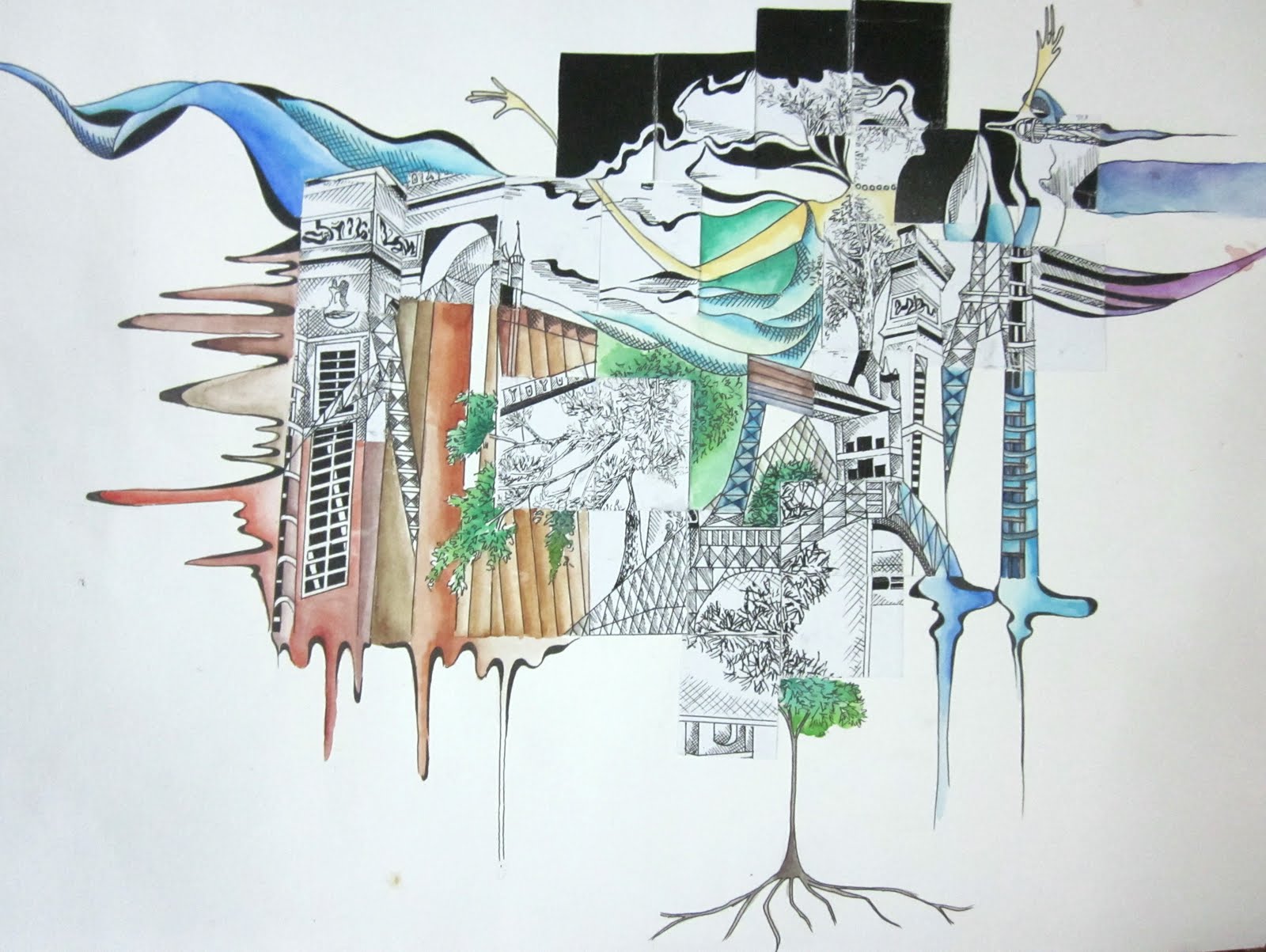
Firstly, i constructed a realistic europe cityscape including various landmarks ( the lourve and effiel tower). Secondly, i cut up the landscape into small square and tried to fit them together where they seem to fit while filling up the parts that cannot be joined. Surprisingly, amongst the irrational combination of the parts, i found a shape the seemingly looks like the side profile of a woman. Thus, i worked on that i managed to integrate a figure of a flying angel in the painting, making it surrealistic.